By Enedina Guerrero
I would like to share a resource I often use when studying the Gospels: “The Bible, the Talmud, and the New Testament” by Rabbi Elijah Zvi Soloveitchik.
Rabbi Elijah Zvi Soloveitchik, born in Slutzk, Russia, in 1805, was a prestigious member of the Soloveitchik rabbinic dynasty. He wrote Qol Qore, a rabbinic commentary on the Gospels of Matthew and Mark. He used classic rabbinic literature and works from Moses Maimonides (Rambam) to argue for the compatibility of Christianity and Judaism.
Rabbi Soloveitchik’s rabbinic commentary enhances context and perspective as Yeshua’s language is primarily for the first-century Jew in the Land of Israel.
The introductory quote to this book powerfully conveys the value of what Rabbi Soloveitchik shares with the reader.
“The emergence of Christianity belongs to the history of Judaism.” Franz Delitzsch
It is vain trying to convert a Jew into Christianity. It’s futile, it’s unnecessary, because the foundation of Christian faith is from Judaism. So, we must look at our faith from that perspective.
Using this book, I learned some information about the parables Yeshua shares in Matthew Chapter 13, which can be very confusing when we read them in English.
It gave me a better understanding of why it is important to understand the context, what is being said, and how it’s being presented when we read the scriptures ourselves.
We can step back and ask, “Why is it written this way? Why am I hearing it from this perspective? “How am I supposed to make sense of what is being said? “
Because quite often, we try to look at scripture from our 21st-century perspective.
And that’s not applicable to a first-century Jewish community living under Roman oppression, in an agricultural space, living in an environment where Yeshua relied on visual association with where they lived, the work they performed, and the locations they traveled to.
Let’s look at Matthew 13:24-30 (Complete Jewish Bible [CJB])
Yeshua put before them another parable. “The Kingdom of Heaven is like a man who sowed good seed in his field; but while people were sleeping, his enemy came and sowed weeds among the wheat, then went away.
When the wheat sprouted and formed heads of grain, the weeds also appeared.
The owner’s servants came to him and said, ‘Sir didn’t you sow good seed in your field? Where have the weeds come from?’
He answered, ‘An enemy has done this.’ The servants asked him, ‘Then do you want us to go and pull them up?’
But he said, ‘No, because if you pull up the weeds, you might uproot some of the wheat at the same time.
Let them both grow together until the harvest; and at harvest-time I will tell the reapers to collect the weeds first and tie them in bundles to be burned, but to gather the wheat into my barn.’ “
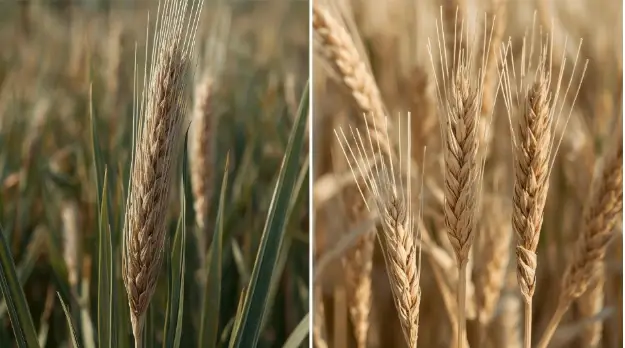
Rabbi Soloveitchik explains in his book ‘Darnel (tares) – the Rambam said that it was a type of wheat that changed form and structure. Therefore, it is called zunin/tare, for it has deviated from the correct path, just as “their hearts strayed [zoneh/prostitute] (Ezekiel 6:9).”’
What was Yeshua’s intent with this parable?
At first glance, the tares look like wheat. Although they start looking like wheat, they start morphing and changing.
That’s why the field owner said, “Don’t pull out the weeds,” because doing so might harm the wheat.
In this parable, the wheat are the good people, and the tares are the bad people. Yeshua’s warning is to be aware of the people among us who are acting righteously.
But inside… They’re full of deceit and teach others the wrong path.
We must be aware of those situations. We must be wise.
We must look at the actions, not just listen to the words spoken, as a person’s good deeds and actions will prove that they are on the correct path to G-dliness.
If someone is teaching concepts that lead you astray from G-d and His word, they might be that tare.
Anyone trying to influence you to move away from G-d is taking you on the wrong path.
“Your word is a lamp for my foot and light on my path.” Psalm 119:105 (CJB)
Soloveitchik, Rabbi Elijah Zvi. 2019. The Bible, the Talmud and the New Testament. University of Pennsylvania Press, Philadelphia, Pennsylvania.