BY ENEDINA GUERRERO
Chanukkah isn’t in the Torah. You won’t find its observance commanded alongside the seven Appointed Times listed in Leviticus 23 or Numbers 28–29. Yet this eight-day celebration carries profound meaning for both Jews and Christians today, especially as we navigate what it means to remain faithful to the G-d of Abraham, Isaac, and Jacob in a world that constantly pressures us to compromise.
The Greek Problem: When Culture Becomes Oppressive
In 332 BCE, Alexander the Great conquered Jerusalem without a battle. The Jewish historian Josephus records that the high priest, accompanied by a retinue of priests garbed in white and a crowd of citizens, went out to meet Alexander. As they drew near, Alexander respectfully bowed before the high priest, recognizing the Name of G-d engraved on the golden plate he wore on his forehead.1 Unlike other conquerors, Alexander allowed the Jews to live according to their ancestral laws, provided that they agreed to certain conditions.2 This peaceful transition seemed initially promising.
Little did they realize that through Alexander’s military conquest, he was setting the stage to present his “gift” to the world—Hellenism, the Greek way of thinking and living that promised to civilize the “backward” peoples of the East. After his death, his empire fractured, and Jerusalem found itself caught between the Ptolemies of Egypt and the Seleucids of Syria. In 198 BCE, after many years of fighting between these two groups, Antiochus III wrested control of Israel from Ptolemy V. But everything dramatically shifted for the people of Israel when Antiochus IV Epiphanes took the Seleucid throne in 175 BCE, after the deaths of his father and brother.3
Antiochus didn’t merely want political control; he wanted philosophical conformity. 1 Maccabees describes how he “sent letters by messengers to Jerusalem and the towns of Judah; he directed them to follow customs strange to the land, to forbid burnt-offerings and sacrifices and drink-offerings in the sanctuary, to profane sabbaths and festivals.”4 This wasn’t about taxes or territory; it was about forcing Jews to abandon their covenant with G-d that made them who they were.
Living according to G-d’s commands in the Torah suddenly became dangerous. Jewish mothers were executed for circumcising their sons.5 Sabbath observance became punishable by death. The Temple—the dwelling place of G-d’s presence—was desecrated with pig’s blood and rededicated with the name Zeus Olympios.6 According to 1 Maccabees, under Antiochus’ orders, “On the fifteenth day of Chislev, in the one hundred and forty-fifth year, they erected a desolating sacrilege on the altar of burnt-offering.”7
While Antiochus’ demands and his desecration of the Temple wreaked havoc on those loyal to G-d, assimilation became too enticing, causing many Jews to comply. Some saw Hellenization as progress, a way to join the sophisticated world of Greek philosophy and culture, while others deeply feared for their lives. However, a remnant boldly refused to cave in to the pressure or allure of it.
When Ordinary People Said, “Enough”
One such bold soul was Mattathias, an elderly priest living in Modein, a small town outside Jerusalem. When a royal official arrived to enforce the king’s decree to sacrifice to pagan gods, he demanded that Mattathias be the first to perform it. The old priest not only refused outright, but he also killed both the official and the apostate Jew who stepped forward to comply. Afterward, he tore down the altar, then he and his five sons—Judah, John, Simon, Eleazar, and Jonathan—fled to the hills and began a war that seemed impossible to win.8
Mattathias wasn’t a general or a politician. Since he was a priest, he should have been teaching Torah and offering sacrifices. Yet when the moment came to choose between survival and faithfulness to G-d, he chose G-d. His son, Judah, who became known as “the Hammer” (Maccabeus), rallied a ragtag army of pious Jews who would rather die than abandon their covenant with G-d.
For three years, they fought—using guerrilla tactics—against trained Greek soldiers, overwhelming odds, and an empire that controlled most of the known world. Josephus records that Judah’s brother, Eleazar, died in battle when he crawled under an elephant and stabbed it from below, causing the beast to collapse on him.9 That’s the kind of desperate courage these men had. They were willing to lose their lives for the chance to strike even one blow for freedom.
In 164 BCE, the Maccabean army retook Jerusalem. 1 Maccabees relates what they encountered as they walked onto Temple Mount: “There they saw the sanctuary desolate, the altar profaned, and the gates burned. In the courts they saw bushes sprung up as in a thicket, or as on one of the mountains. They saw also the chambers of the priests in ruins.”10 Seeing the devastation, they made cleansing the Temple their highest priority.
The Jewish Sages wrote in the Babylonian Talmud, Tractate Shabbat 21b, that the priests needed to purify the Temple and relight the menorah. But they could only find enough uncontaminated oil to light the menorah for one day. According to tradition, the oil miraculously burned for eight days—exactly the amount of time needed to press and prepare new oil in accordance with Torah requirements. On the twenty-fifth of Kislev, they rededicated the Temple. 1 Maccabees records: “So they celebrated the dedication of the altar for eight days, and joyfully offered burnt-offerings; they offered a sacrifice of well-being and a thanksgiving-offering.”11
The Roman Sequel: Repeating History
Fast forward two centuries. Rome now controlled Jerusalem, and once again, Jews faced pressure to compromise their faith. Because the Romans were more pragmatic than the Greeks, they didn’t care what the population believed, as long as they acknowledged Caesar’s divinity and paid their taxes. For Jews, the former expectation was impossible. It would have been a direct violation of their daily proclamation of “Hear, O Israel: The LORD our God, the LORD is one.”12 No emperor, no matter how powerful, could share G-d’s glory or throne.
Tensions that had built up over decades finally exploded in 66 CE, when Jewish rebels attacked the Roman garrison. Four years later, General Titus destroyed the Temple that the Maccabees had sacrificially fought to restore. Josephus, who witnessed the destruction, wrote that the Romans had “set fire to the Temple…”13 This time, the abomination of desolation was not caused by Antiochus but by the Roman conquerors, fulfilling Daniel’s prophecy (Daniel 9:27), for a second time.
But the challenge didn’t end there. Jews, scattered across the Roman Empire, continued to gather in synagogues, study the Torah, and observe the Shabbat (Sabbath). During this period, something unexpected happened: Gentiles began joining them. These “G-d-fearers” were drawn to the ethical monotheism of Judaism, the moral clarity of the Torah, and the consistent drive of a people who had suffered everything, yet remained faithful.
It was in the synagogues that these Gentiles encountered the Jewish followers of Yeshua. However, with the ever-growing persecution from Rome, the Jews and G-d fearing Gentiles found themselves wrestling with the same questions: How do we remain faithful to G-d in an empire that demands conformity? What does it mean to be holy, set apart, when the whole world demands us to blend in?
Our Chanukkah Challenge
As I studied this history, I realized that both the Greeks and Romans proposed the same “deal”: Compromise a little. Just participate in the civic and pagan temple ceremonies. Just acknowledge the emperor as “god.” For us today, this translates into: “Just eat the non-kosher food at the business dinner.” “Just work on Shabbat, if that’s what your employer requires.” “Just blend in, then you can have peace, prosperity, and success.”
The Maccabees said no. The Diaspora Jews said no. The early believers, both Jewish and Gentile, said no. They chose the light of Torah over the darkness of compromise, even when that choice cost them everything.
Today, both Jews and Christians face versions of the same pressure. We’re told that our beliefs are outdated, offensive, and intolerant. We’re pressured to redefine marriage, to celebrate what G-d calls sin, to abandon the biblical sexual ethic, and to treat Scripture as culturally conditioned rather than divinely inspired. The terms may have changed, but the demand is still the same: Conform. Compromise. Extinguish your light.
Chanukkah reminds us that a small flame, properly tended, can push back an ocean of darkness. When Mattathias lit that first spark of rebellion, he couldn’t have known it would grow into a flame that would restore the Temple. When the priests found that single cruse of uncontaminated oil, they couldn’t have known it would burn for eight days. They all resolutely chose to do what was right and let G-d handle the impossible.
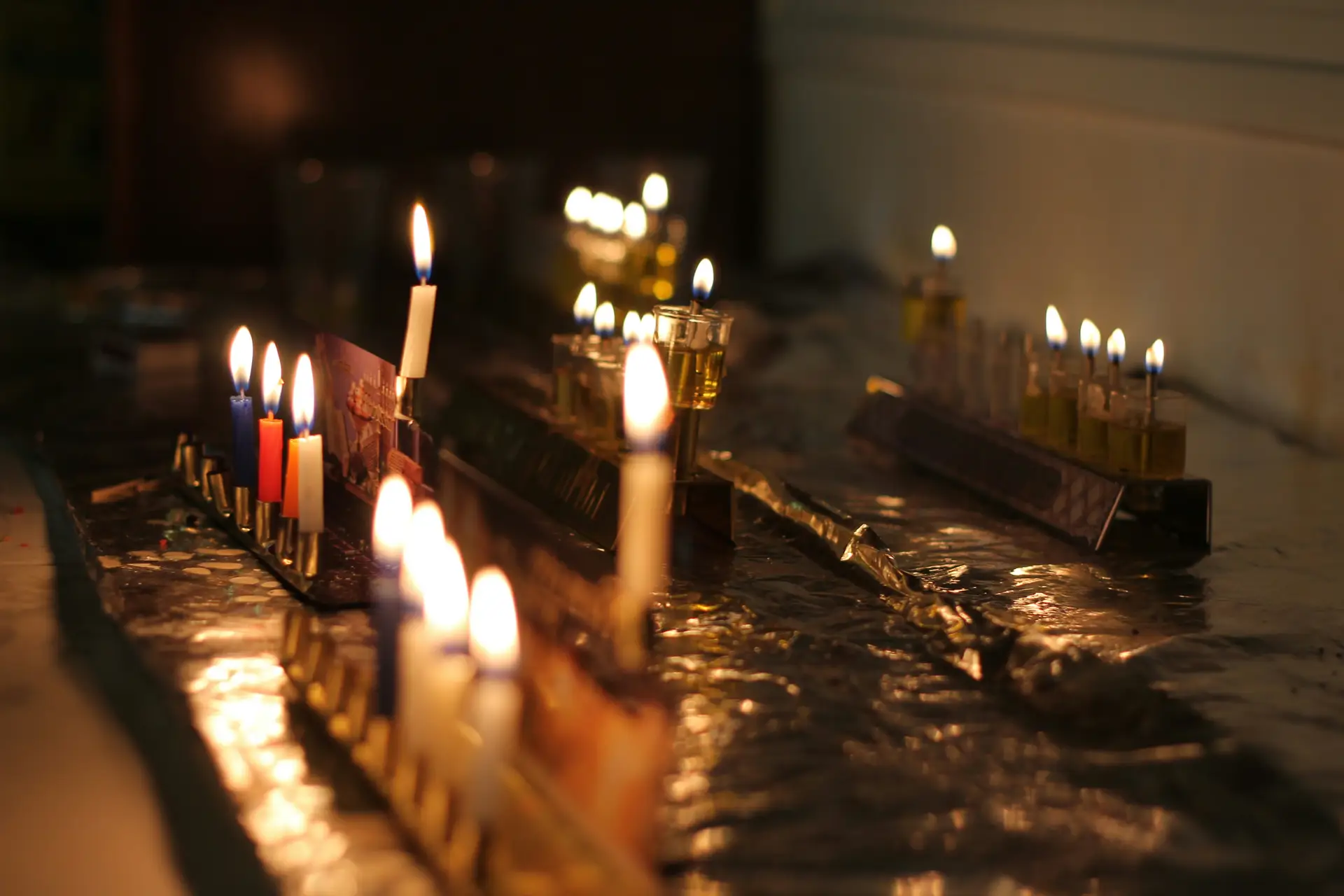
Each night of Chanukkah, when we light the menorah, we’re not merely celebrating a military victory or freedom from a political power. We’re celebrating the choice to remain faithful even when faithfulness seems foolish or dangerous. We’re declaring that the G-d of Abraham, Isaac, and Jacob is still our G-d, regardless of what empires rise and fall around us.
As Christians, we often forget that Yeshua celebrated Chanukkah. He walked in the Temple during the Feast of Dedication because He was prophesied to be that light during the darkness of the Roman conquest. Since holiness means separation, expressing our love for G-d demands that we say no to the world so we can say yes to G-d—to be a light to the world around us, imitating our Messiah.
Jews and Christians, together, can learn from Chanukkah. We serve one G-d. We honor one Torah. We await one final redemption. And until that day comes, we must keep the light burning, one candle at a time, one choice at a time, one act of faithfulness at a time.
The oil shouldn’t have lasted. The rebellion shouldn’t have succeeded. The Temple shouldn’t have been restored. But G-d is faithful to do what shouldn’t be possible when His people refuse to compromise.
This Chanukkah, as you light the candles, remember: You’re not just commemorating an ancient miracle. You’re participating in an ongoing one—the miracle of a people who chose G-d over empires, light over darkness, faithfulness over compromise.
May we have the courage to do the same.
Footnotes
- Josephus, Antiquities of the Jews, Book 11, Chapter 8, Section 5. Found at: https://www.gutenberg.org/files/2848/2848-h/2848-h.htm#link112HCH0008
- Note: Two of the conditions Alexander the Great requested were that for an entire year, all male babies would be named Alexander and that Israel would pay him tribute as a province of Greece (Bernstein, Rabbi Steven. Course notes from The Loudest Silent Years in History. Yeshivat Shuvu).
- Hoppe, Leslie J. “Seleucid Dynasty.” Ebesco. Found at: https://www.ebsco.com/research-starters/history/seleucid-dynasty
- 1 Maccabees 1:44-45 (NRSV)
- 1 Maccabees 1:60-61
- 2 Maccabees 6:2
- 1 Maccabees 1:54
- 1 Maccabees 2:15-28
- Josephus, Antiquities of the Jews, Book 12, Chapter 9, Section 4. Found at: https://www.gutenberg.org/files/2848/2848-h/2848-h.htm#link122HCH0009
- 1 Maccabees 4:38
- 1 Maccabees 4:56-59
- Deuteronomy 6:4
- Josephus, The Wars of the Jews, Book 6, Chapter 4, Section 5. Found at: https://avande1.sites.luc.edu/jerusalem/sources/wars6.htm